
Memory prices have been one of the wildest stories in technology markets over the past year.
At ReMarkets, we’ve had a front-row seat — not just watching prices move, but watching the decisions behind those moves. Every day we work with customers, suppliers, brokers, and partners navigating one of the most unusual memory markets we’ve seen in years.
Over the last twelve months, I’ve had countless conversations that all seem to come back to the same question: has the recent correction changed the long-term outlook for DRAM?
My answer is no.
I believe the recent correction deserves more context than many of the headlines have provided. While prices have certainly moved, I don’t believe the underlying story has. Here’s what we’re seeing — and why I think the next chapter of this market is still being written.
The recent correction reflects market mechanics more than a collapse in underlying demand.
While short-term pricing has softened, the structural forces that created this environment remain largely intact. Understanding the difference between market sentiment and underlying fundamentals is becoming increasingly important for organizations responsible for technology procurement, infrastructure planning, and asset disposition.
How We Arrived Here
Beginning in the second half of 2025, DRAM pricing accelerated at a pace few expected. A 32GB DDR4 kit that sold for roughly $60–90 in October 2025 was fetching approximately $150–180 by January 2026. During that same window, DDR4 16Gb spot prices increased by more than 2,200%.
Not a typo.
The chart below shows just how far 32GB DDR4 kit pricing moved in a single quarter. DDR4 16Gb spot chip prices — a different, more volatile measure — climbed even further over the same window, as noted below the chart.
32GB DDR4 Kit Pricing
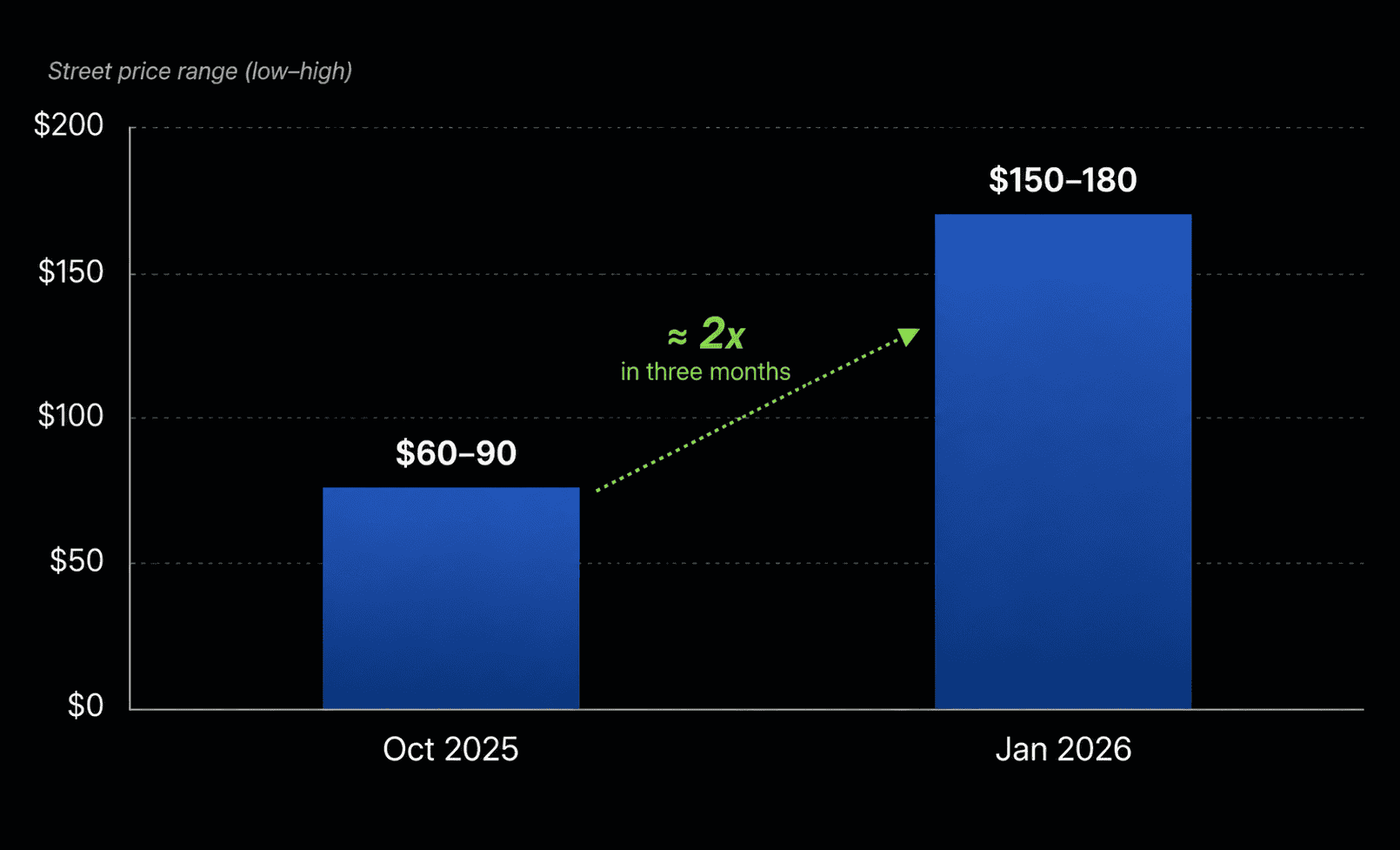
32GB DDR4 kit street pricing increased from approximately $60–90 in October 2025 to approximately $150–180 by January 2026.
Source: ReMarkets analysis using Tom’s Hardware RAM Price Index data.
The Forces Behind the Surge
Three structural dynamics converged to create an unprecedented supply-demand imbalance.
CAPACITY SHIFT TO HBM
Traditional DRAM → HBM for AI (High Bandwidth Memory). HBM consumes ~3x the wafer area of standard DRAM per GB. Every AI chip produced eliminates capacity for three consumer memory chips.
AI INFRASTRUCTURE DEMAND
Reports and market expectations around large-scale initiatives like Stargate signaled unprecedented future demand, driving manufacturers to secure supply far in advance — anticipated demand, not signed contracts.
DDR4 PARADOX
Manufacturers exited DDR4 to chase higher-margin DDR5 and HBM, while hundreds of millions of legacy systems continued to require it — creating a premium for an “older” generation.
Figure 1. Three structural forces reshaped the memory market: production capacity shifted toward HBM, AI infrastructure expanded future memory requirements, and resilient legacy demand sustained pressure on DDR4 supply.
Source: ReMarkets analysis.
At one point, DDR4 traded at a premium over DDR5 — a remarkable inversion that few predicted.
The Stargate Demand Signal
The second structural force wasn’t actual memory consumption — it was the expectation of future memory consumption. Manufacturers restructured supply chains around reports that Stargate had locked up roughly 40% of global DRAM supply. The catch: those were demand expectations, not binding contracts. Manufacturers plan years ahead, and anticipated AI demand became part of the supply story regardless.
Understanding the Correction
Spot prices in China’s channel market corrected sharply in March 2026. But contract prices — where OEMs and system builders actually buy — have remained far more resilient.
DDR4 vs. DDR5 Spot Price
Comparative spot-market pricing across the recent market cycle.
Source: Tom’s Hardware RAM Price Index 2026
Spot vs Contract Price Divergence
Spot (China Channel) Contract (Global OEM)
Source: TrendForce Q1 2026 DRAM Analysis
That's Not a Demand Signal. That's Market Mechanics.
The correction appears driven more by inventory liquidation and speculative unwinding than collapsing demand. Channel traders who stockpiled at peak prices moved quickly to lock in gains — that’s a trading behavior, not a shift in end-market appetite.
TrendForce continued projecting 58–63% quarter-over-quarter growth in DRAM contract pricing for Q2 2026, even as spot prices pulled back. Spot markets react to emotion. Contract markets reflect purchasing commitments.
TurboQuant Is Real. I Just Don't Think It Changes the Story.
Google’s TurboQuant — a compression algorithm claiming to cut AI inference memory
requirements by roughly 6x — is a meaningful breakthrough. But history suggests efficiency
expands adoption rather than reducing infrastructure investment. Virtualization didn’t eliminate
servers. Cloud computing didn’t eliminate data centers. Storage compression didn’t reduce
storage demand. I believe AI will follow the same pattern.
Supply Constraints Have Not Disappeared
The fundamentals that drove prices up haven’t materially changed. Here’s where supply actually stands.
Why the Fundamentals Haven't Changed
- Micron sold its entire 2026 HBM output before the year started
- SK Hynix has 2026 production essentially fully allocated
- New fab capacity won't meaningfully contribute until late 2026 at earliest
- Gartner projects 80% DRAM price inflation for full year 2026 ("memflation")
Supply Timeline
My View on the Next 6–18 Months
Based on today’s manufacturing commitments, production timelines, and ongoing AI investment, I expect a period of stabilization followed by renewed upward pressure through the second half of 2026.
Why This Matters Beyond Memory Pricing
Memory is no longer simply a commodity. It has become a strategic asset whose value is increasingly tied to global AI infrastructure investment and supply chain dynamics.
Organizations that treat memory as a strategic asset rather than a commodity will be better positioned to navigate the years ahead — whether that means procurement timing, inventory strategy, or planning for asset disposition.
Corrections are natural. Headlines change. Spot prices move. The more important question is whether the underlying story has changed. From where I sit, I don’t believe it has.
The correction changed the conversation. I don't believe it changed the story.